
Full-Arch Dental Implants in Plano, TX: Cost Factors, Process, and Who May Be a Candidate

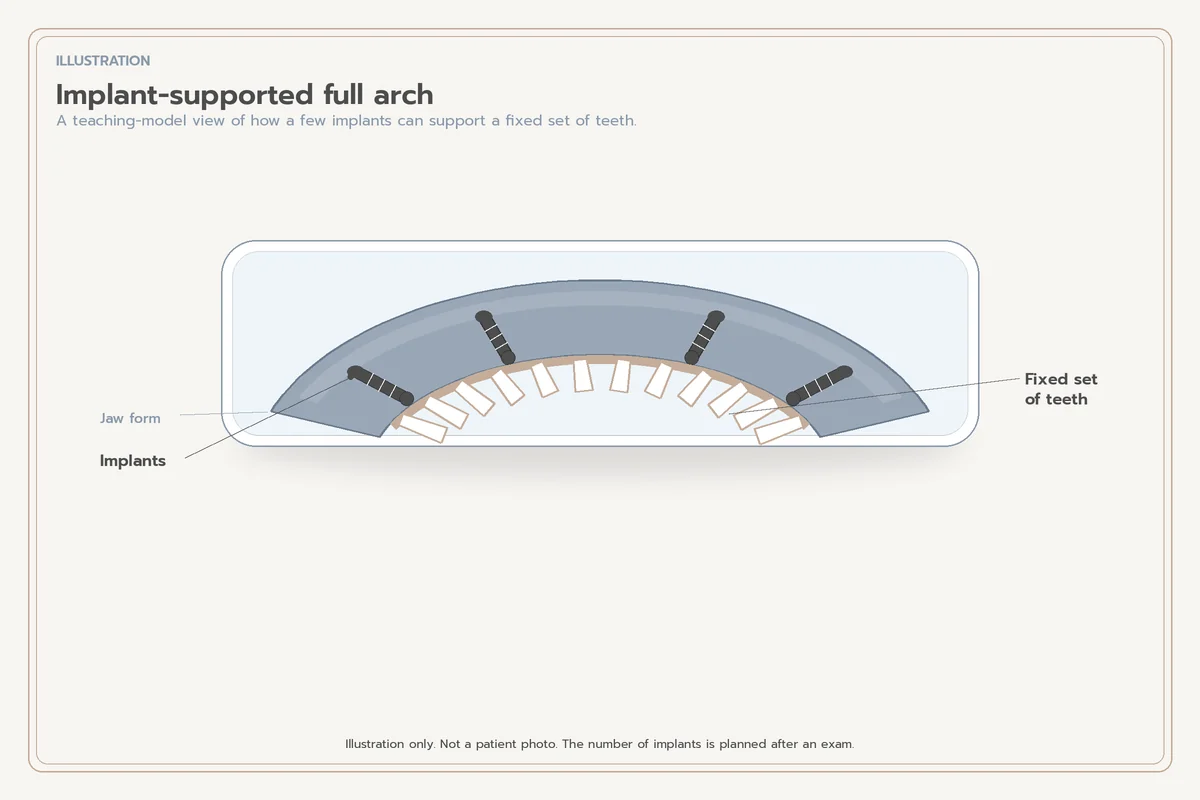
Full-arch dental implants replace a full upper or lower row of missing or failing teeth by using a small number of implants to support a fixed set of teeth. At Diamond Dental Studio in Plano, TX, full-arch care typically uses 4 to 6 implants per arch (All-on-4 or All-on-6), with the exact plan decided after an exam and digital imaging — not a pre-set package — so you can see whether this option, a denture, or another plan fits. This article explains how the process usually works, what tends to affect cost, and who may be a candidate. Individual results vary.
What full-arch dental implants are
A dental implant is a small post placed in the jaw to stand in for a tooth root. After it has healed and joined with the bone, it can hold a crown, a bridge, or a larger set of teeth. Full-arch treatment uses that same idea for a whole upper or lower row, rather than placing one implant for every missing tooth.
In a typical full-arch plan here, 4 to 6 implants support one connected set of teeth for that arch (All-on-4 or All-on-6). Those teeth are designed to stay in place during eating and speaking, rather than resting on the gums the way a removable denture does. Diamond Dental Studio offers this care, including the option described on our full-arch implant service page.
Dr. Loi Ta is a general dentist offering dental implants, veneers, and full-mouth rehabilitation. Many patients choose Dr. Ta for the time he takes to listen and explain options.
How this compares with a single implant or a denture
It helps to separate three common paths:
- A single implant replaces one tooth with one implant and a crown, often when the neighboring teeth and gums are otherwise healthy. See what to know before getting implants and how to choose an implant dentist in Plano.
- A removable denture replaces many or all teeth in an arch and can be taken out to clean. Snap-on dentures use implants for extra hold but are still removed for daily care. See also implants and dentures.
- Full-arch implant teeth are a fixed set of teeth for a whole upper or lower row. They are cleaned in the mouth, like a bridge, and do not come out at night.
None of these is automatically right for every person. If many teeth are worn, damaged, or missing, and the bite needs to be rebuilt, full-mouth rehabilitation may be the broader plan, with implants as one part of it. Individual results vary.
Who may be a candidate
You may be a candidate if you are missing many teeth in one arch, if remaining teeth cannot reasonably be saved, or if a denture feels loose and you want a fixed option. An exam is what settles that question. Age alone does not.
During that visit, Dr. Ta looks at your gums, the amount and quality of bone in the jaw, your bite, and any teeth that may need to be treated or removed first. He also reviews your medical history, medications, and habits such as tobacco use, because those can affect healing. If gum disease, decay, or an infection is present, that usually needs attention before implants are placed.
Bone grafting is often part of full-arch treatment. Whether it is needed, and how it is sequenced, is decided after an exam and digital imaging. Needing this step does not automatically rule you out; it simply means the timeline should include that work. If implants are not a good fit right now, or if you prefer a removable option, a conventional denture or a snap-on denture may be more appropriate.
What the process usually looks like
Every case is planned individually, so the number of visits and the calendar can differ. In general, full-arch care follows a few stages.
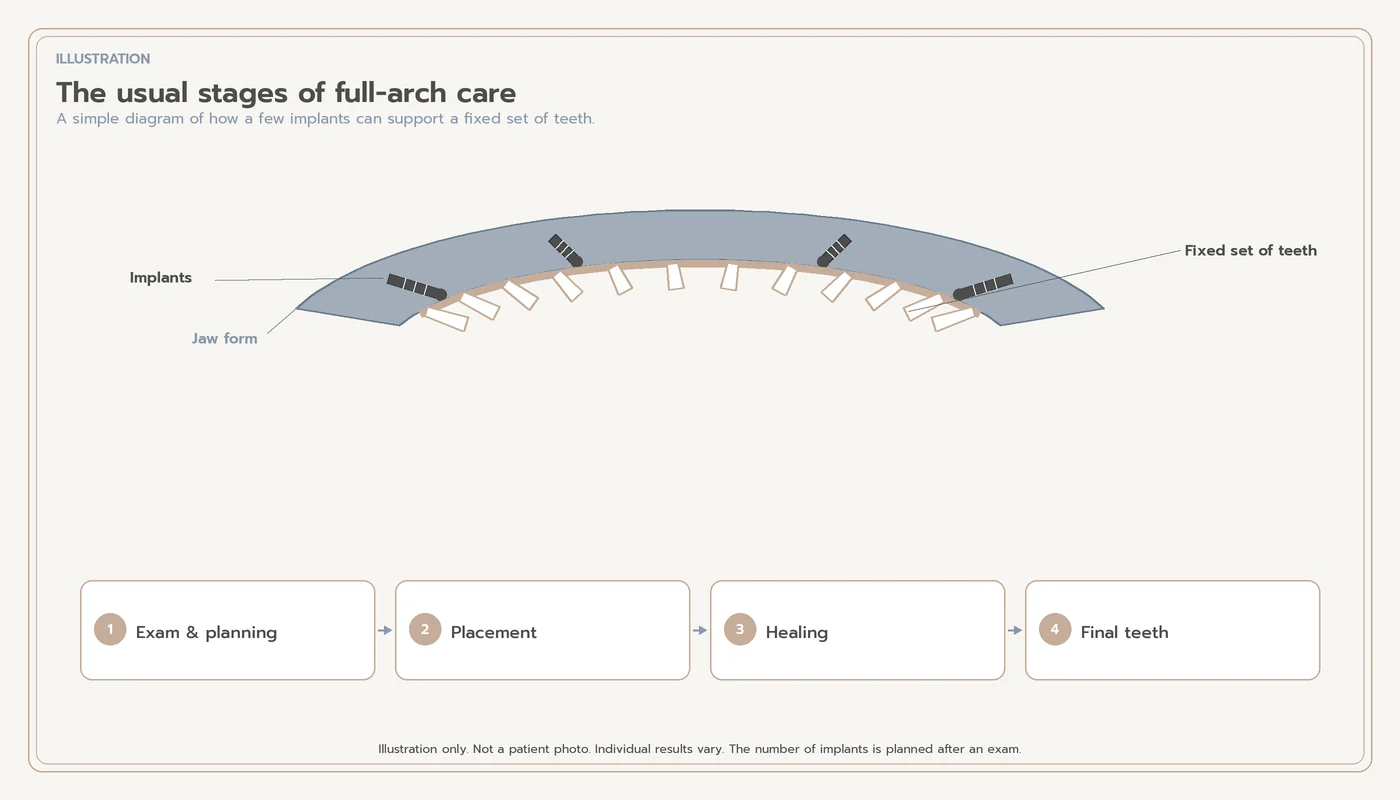
Exam and planning
The first visit is for listening and gathering information. That usually includes a conversation about what is bothering you, a look at your teeth, gums, and bite, and an exam and digital imaging as needed. You should leave with a clear explanation of whether you appear to be a candidate, what alternatives exist, and what would happen next.
Preparing the mouth, if needed
If teeth need to be removed, if the gums need treatment, or if bone grafting is needed, that work is built into the plan first, or combined with implant placement when it is appropriate. Ask about comfort during a longer visit. Moderate to deep IV sedation is an option to discuss; whether it is appropriate depends on your exam and health history.
Implant placement and, in some cases, temporary teeth
On the surgical visit, the implants — typically 4 to 6 per arch — are placed in planned positions in the jaw. A temporary set of teeth is often possible the same day when it is planned for, so you are not without teeth while the implants heal. Whether that is appropriate depends on your exam, including implant stability, bone support, and your overall health. It is not guaranteed for every patient.
Healing and the final teeth
The implants need time to join with the jawbone before the final teeth are made and attached. Healing often takes several months. Once healing has been checked, the final implant restoration is designed, tried in, and adjusted for bite and speech. The look and material of the temporary and final teeth depend on the treatment plan for your case. Individual results vary.
Follow-up and daily care
Fixed implant teeth still need daily cleaning and regular visits. You will be shown how to clean around the implants and under the teeth, and the fit, gums, and bite will be checked over time. Your team will give you care instructions, such as diet and nighttime protection, based on your plan. How the work holds up depends on health, home care, and follow-up. Individual results vary.
What affects the cost of full-arch implants in Plano
There is no single price that fits every full-arch case, and this article does not quote one. A useful estimate comes after an exam, and it should spell out what is included.
Cost often depends on:
- Whether one arch or both arches are being treated
- Whether teeth need to be removed
- Whether gum treatment or bone grafting is needed first
- The design and material of the temporary teeth and the final teeth
- Imaging, surgical time, and any sedation that is part of the visit
- How many follow-up visits and adjustments are included
When you compare estimates, ask what is in the fee and what could be added later. Two quotes are hard to compare if one includes the final teeth, extractions, and follow-up, and the other does not.
Diamond Dental Studio is an out-of-network office, by choice, so insurance companies don’t dictate how Dr. Ta practices or limit the care he provides. You can still use your benefits — we submit the claim for you and let you know your portion once it comes back. Coverage varies by plan, and no office can promise that a plan will pay a certain amount. See our page on dental insurance and financing. Flexible financing options may be available — ask our team.
A straightforward next step
If you are considering full-arch dental implants in Plano, a conversation and an exam are the most useful place to start. Call Diamond Dental Studio at 972-608-1811. We are at 5938 West Parker Rd, Suite 200, Plano, TX 75093. Dr. Ta can review your mouth, explain the options that fit, and help you decide whether full-arch implants are appropriate, or whether another path makes more sense. Individual results vary.
Frequently asked questions
How much do full-arch dental implants cost in Plano, TX?
The fee varies with the number of arches treated, any extractions or preparatory care, the type of temporary and final teeth, and what is included in the quote. After an exam, you should receive a written breakdown of the recommended plan. Flexible financing options may be available — ask our team.
Who may be a candidate for full-arch implants?
People missing many teeth in one arch, people whose remaining teeth cannot reasonably be saved, or people who want a fixed alternative to a loose denture may be candidates. Candidacy depends on gum health, available bone, medical history, and habits that affect healing. An exam is required.
What’s the difference between All-on-4 and All-on-6?
Both are full-arch implant approaches. All-on-4 uses four implants to support a fixed set of teeth for one arch, and All-on-6 uses six. Which plan fits is decided after an exam and digital imaging. Neither approach is automatically the right choice for every person.
Is bone grafting needed for full-arch implants?
Bone grafting is often part of full-arch treatment. Whether it is needed in your case is decided after an exam and digital imaging. If grafting is part of the plan, it is scheduled before implant placement, or combined with placement when that is appropriate.
Can I get teeth on the same day as implant placement?
A temporary set of teeth is often possible the same day as surgery when it is planned for. That depends on your exam, and it is not guaranteed for every patient. Individual results vary.
How long does full-arch implant treatment take?
Planning, any preparatory care, implant placement, healing, and the final teeth are usually spread over several months. The calendar is shorter for some people and longer for others if gum treatment or bone grafting is needed first.
Does dental insurance help with full-arch implants?
Possibly, in part, depending on your plan. Diamond Dental Studio is out of network with all insurance companies, by choice. You can still use your benefits: the office submits the claim for you and tells you your portion once the claim comes back. No one can promise that a plan will pay a set share of implant care.
How are full-arch implant teeth different from dentures?
Traditional dentures rest on the gums and are removed for cleaning. Full-arch implant teeth are supported by implants and are designed to stay in place. A snap-on denture uses implants for hold but is still taken out daily. Comfort, chewing, cleaning, and cost differ, and the comparison depends on your exam and preferences. Individual results vary.
How do I care for full-arch implants?
Brush, clean under and around the teeth as instructed, and keep regular dental visits so the implants, gums, and bite can be checked. Your team will give you care instructions, such as diet and nighttime protection, based on your plan. Individual results vary.